AI personalization is only as good as the data behind it
/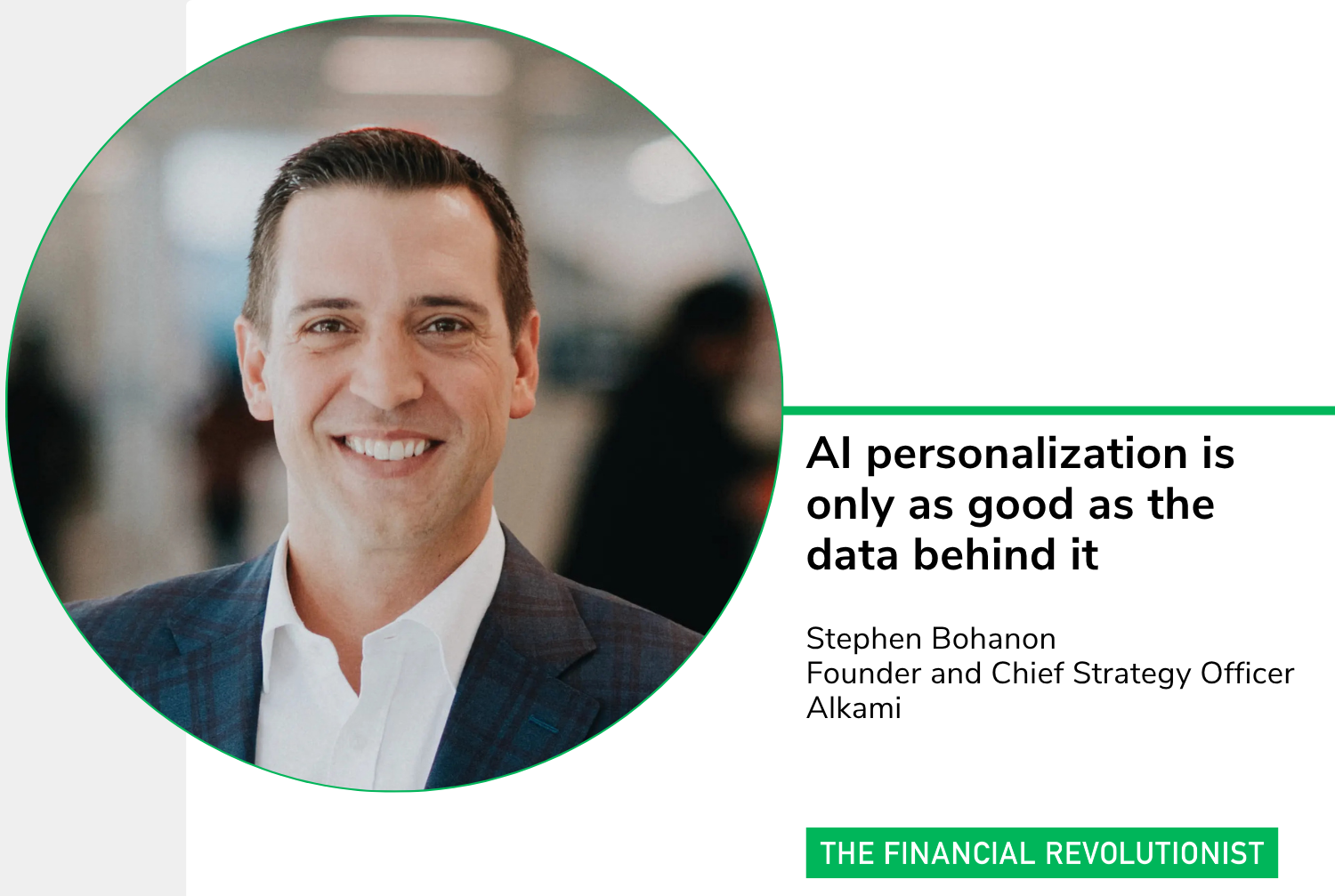
The FR spoke with Stephen Bohanon, founder and chief strategy officer at digital banking company Alkami, about why data often is the biggest barrier to meaningful AI adoption.
Why does data fragmentation get in the way of AI deployments?
If you want to deploy an AI agent to automate a back-office workflow, you can't just point it at one data source — it needs access to data across multiple systems. Larger institutions have long-running data initiatives to stitch things together, but this remains a challenge for many community banks and credit unions.
What are the biggest obstacles community banks and credit unions face in getting their data ready for modernization?
One of the biggest obstacles is the structuring and cleansing of data. Their data resides in many different places. When we started Alkami, we were connecting to about eight third-party systems to go live with a customer. Today that number is 18 or 19. Every single one of those systems has their own data and their own data structure. So just getting it out of those systems, getting it into a normalized function — that's the number-one problem. How do I curate all this data into something that's meaningful, that can actually lead to an action, that I can leverage to either drive revenue or lower the cost of my organization?
Are there other major obstacles to mainstreaming AI at banks and credit unions?
On the bank side, part of it is the talent and the know-how internally. Banks are much more likely to outsource all of their technical prowess to a set of large technology providers. Credit unions have historically been technology-forward, but the obstacle still comes down to technical access to those systems.
The bigger issue is what I'd call the mental model of the entire framework — the rules, permissions, limits and parameters, the compliance, the regulation. You have to have that mental model of the entire framework before you go off and just apply an AI agent to something. A lot of generative AI today is really built for industries that have a tolerance for error. That is not something that can happen in our industry.
FIs have long talked about moving from transactional relationships to deeper ones, and data is an important part of this. Why has this been so hard?
There is a certain lack of proximity that a bank or credit union employee now has with a customer. You're not going to the branch as much anymore, so it's hard to gain a lot of insight about you, and it's hard to use those opportunities to ask, ‘How's it going? What are your needs?’ But the really great thing is [we] actually know a lot more about the customer or member based on organic interactions that might happen once a month when they come into a branch. Through transactions, we create what we call key lifestyle indicators. For example, we know whether or not you're married or single, whether or not you have kids, whether or not you like to travel, whether or not you're a foodie. [FIs] that are using that information to do proactive outreach are performing better financially across all metrics.
Is there a point where data-driven personalization starts feeling invasive?
There are certain things that people would find spooky. The line that financial institutions have to toe is: how do I give this personalized suggestion or recommendation without it feeling like I've hacked into their life? Because of your transactions we may know you'd just had a child — and if you got a congratulatory note, that's almost creepy! You have to be careful. But we have the ability to be very personalized. Our toolset, for example, has tens of thousands of key lifestyle indicators. We know all the banking relationships people have across everywhere. It's up to the individual bank or credit union to wield that power in a way that comes across as useful.
Are younger customers less loyal to community institutions than their parents were? What can FIs do to prevent churn?
I don't really know that people are ever loyal to a financial institution. I think they're loyal to whatever goals they have in their life. If your goal is convenience or speed or saving money, as long as that institution continues to provide that, you're loyal to it.
You're loyal to an experience. Someone that before was loyal to their branch down the street because it was convenient — [but] now what is convenient is the fact that within minutes, from your couch in your pajamas, you can open up an account and do your banking. The loyalty could be to getting access to your paycheck earlier.
The institutions that win have to be able to serve across the entire demographic spectrum: the people who, for something high-risk or high-value, want to talk to someone and walk into a branch, and the people who never want to talk to someone. You have to be able to serve both.